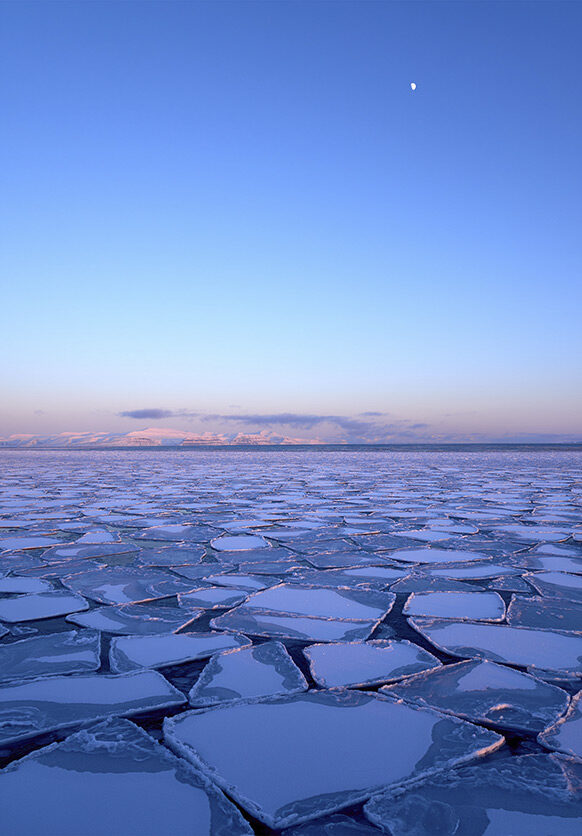
What Lies Beneath
Alexis Rosenfeld
If you were a visitor from another world, first laying eyes on Earth from space, you might very well think it a water planet. At other angles, with 71% of the surface covered in water, you might still be inclined to ask where the intelligent life on this blue planet was more likely to reside?
Intelligence and education are at the heart of Alexis Rosenfeld’s work. Leading the Fondation 1 Ocean, an exploration project supported by UNESCO, Alexis and his colleagues aim to discover, document and support scientific missions in the oceans – with the ultimate goal of helping us better understand and protect them. And by “us” he means everyone, because the waters of the world are something we all rely on and share responsibility for.
 Sony α1 + FE 12-24mm f/2.8 GM | 1/100s @ f/11, ISO 100
“The project was christened 1 Ocean because we have literally only one ocean: one that we share and one that we rely on,” Alexis explains. “Our world is interconnected by water. The Mediterranean Sea flows into the Atlantic Ocean, the Atlantic into the Pacific, the Pacific becomes the Philippine and South China seas, and from there the Indian ocean flows back into the Atlantic. Only our seas are connected like this, and it’s something that shows us both the best and the worst of our world.”
“Actions or disturbances in one place will have consequences in another,” Alexis continues, “and of course that’s what we’re seeing today with pollution, habitat loss and extinction. The mission we have is to spread the word about the health and importance of our oceans. While our world and its connections are easily visible from far above, it’s not so simple for us to picture what’s really happening to the world’s water. Our seas and lakes shimmer with reflections, hiding the truth of neglect beneath their waves. That’s the purpose of our newest member, Lily,” he smiles, “and we hope it is going to help us a great deal.”
 © Alexis Rosenfeld | Sony α1 + FE 16-35mm f/2.8 GM | 1/60s @ f/8.0, ISO 1250
Lily is a submersible robot, which Alexis hopes will add considerable possibilities and improve the quality of his underwater work, all of which leads towards the ultimate goal of exploration and education. “I made Lily with Antoine Drancey, head of Black Whales Pictures, and with help in funding and technical support from Sony Europe,” he explains. “Antoine is the pilot, I’m the photographer, and Lily is really like a new pair of eyes for me in the deep. It's designed for depths down to 1,000 metres, can move at five knots and is connected to a remote station by fibre optics so we can see everything as though we were there.”
“Original photography and video are really important in a project like this,” Alexis continues, “because we are constantly discovering new stories in the deep – stories that need to be revealed and shared. Lily has newly designed LED lights which are vital in the depths, but the best of all, it’s designed to fit a Sony Alpha 1 camera and an Atomos recorder, letting us shoot amazingly high-quality RAW stills and 4K or 8K video. And because Sony’s Alpha cameras have a uniformity in design, we can even swap in an Alpha 7S III for low-light video work too.”
The design of Lily and its control system also means that Alexis can make all sorts of changes to exposure, focus, and even zoom settings remotely with immediate effect. “But along with that, another huge advantage is what Lily’s 18-hour battery life is going to help us show.”
 © Alexis Rosenfeld | Sony α1 + FE 16-35mm f/2.8 GM | 1/160s @ f/10, ISO 1250
“Much like the planet’s health, time is not a luxury that underwater photographers usually have,” Alexis explains, “but Lily will grant us something that’s normally only available to land-based photographers. When a wildlife pro shoots in a forest or on a plain, they can stay put for hours or even days, so long as they have a warm jacket and enough food. But in the water, we’re much more limited. We wait for as long as possible, but eventually we have to go back to the surface – and after you go up, you can miss something by only a few minutes. Yet with Lily we can hide, wait, observe and keep subjects under focus for as long as we need! We can do it not only in the deep sea, but also in more modest depths like 20 or 40 metres.”
These abilities have opened huge areas of ocean for Alexis to work in, “and of course it means we can also go to colder places, deeper places, and even hotter places like the deep volcanoes and thermal vents which have unique ecosystems.”
 © Alexis Rosenfeld | Sony α1 + FE 16-35mm f/2.8 GM | 1/80s @ f/7.1, ISO 1250
Sadly, along with the beauty of discovery, much of what Lily is designed to see is more troubling. “Though we can’t share too much about the species we’ve been shooting yet, one of them was the Red Tree Gorgonians in the Mediterranean,” Alexis continues. There is a big problem of deforestation there, because of the way that the sea is warming and changing. These beautiful species live from near the surface down to 200m, and are an important part of the ecosystem, both as food and as refuge for other animals.”
“And then there is plastic,” he says, darkly. “This is a large part of what we’re looking at with 1 Ocean and with Lily. We’re all familiar with the problem, but what we’ll show is that it’s even more scary than people think. Going back to that idea of the seeing beneath the surface, plastic is a chilling example. We know only one or two per cent of marine plastics stay visible on the coast and the ocean’s surface, while 98% goes to the bottom of the ocean…where it causes even more damage and is much harder to remove. Thanks to Lily, we now know about the deep places down around 1,000 metres, which are sadly like huge plastic cemeteries.”
 © Alexis Rosenfeld | Sony α1 + FE 16-35mm f/2.8 GM | 1/100s @ f/10, ISO 1250
“In these places,” he continues, “we can find plastics from 1970 and even earlier. It all comes from what gets dropped in the street, or in rivers, which eventually take it into the sea. So, with the footage from Lily, we aim to show that plastic is not degradable and while it’s out of sight – and out of mind for many people – it doesn’t go away. In fact, it becomes more dangerous as it breaks down into micro and nano plastics. These end up in the food chain and they don’t only kill marine life. Remember this ‘one ocean’ we are all linked by? That means the plastic is coming back to us in our own food, too.”
“Lily is the latest member of our team, and with the Sony Alpha 1 and Alpha 7S III on board, it’s something that’s only going to expand our view of the ocean,” Alexis finishes. “But we’re only at the beginning. Lily hasn't shown us the best yet. In time, I think it will help us discover things we’ve never seen before, both the good and the bad.”
 © Alexis Rosenfeld | Sony α1 + FE 16-35mm f/2.8 GM | 1/250s @ f/6.3, ISO 200
“We have a lot of possibilities and ideas on where we can go, what we can look for, and how we can spread the word about our oceans. It’s not too late to turn things around, and we’re grateful for Sony to be helping us do it.”
Featured products


Alexis Rosenfeld | France
Beneath the surface, another world: my universe, where everything looks like a fairy tale, and takes your breath away.