How Sony is Making Creativity Accessible to all
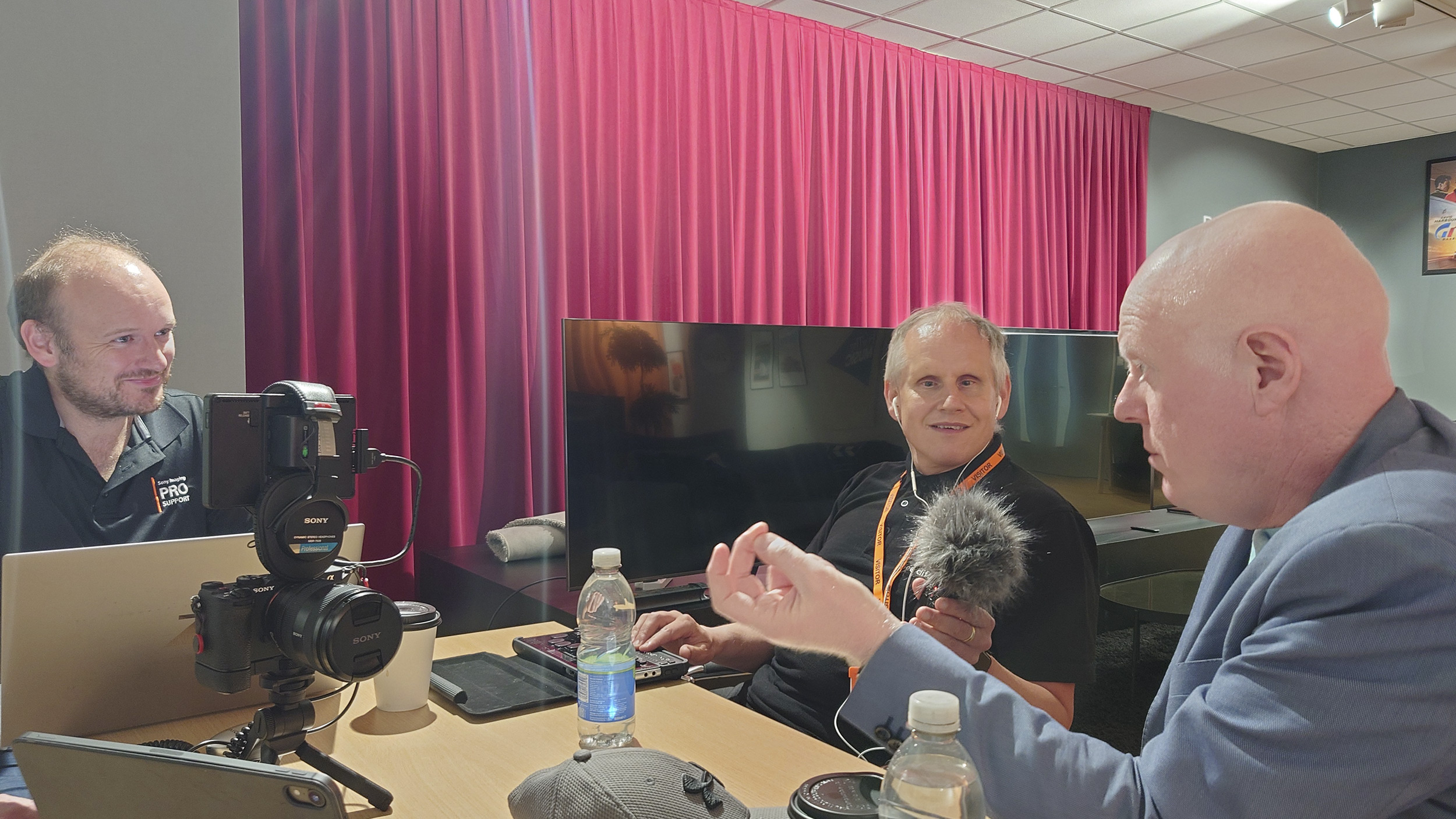
RNIB Connect Radio TechTalk Podcast
As a person who is partially sighted, Robin Spinks is often asked about the apparent contradiction in his choice of hobby. “Someone said to me recently, ‘how can you be low vision and interested in photography? Surely you can't see the pictures properly?’ Now, there's some rationale there, but it also ignores aspects of photography that go beyond the simple recording of a scene. And today’s technology makes photography a lot easier for people like me, too.”
Describing what he experiences with his sight and how it fits with his photography, Robin, who is the Inclusive Design Lead for the Royal National Institute of Blind People (RNIB), says, “I can read the top letter on an eye test chart, but no more than that. I'm told there are other letters, but I just can't see them! It’s true that I can’t look at a scene and give an assessment of it visually in the same way as a person with regular vision,” he continues, “what I can do is compose, take the picture, and explore it later.”
“For me, that’s the biggest thrill of photography: how it helps me understand form, function and texture, the richness of structures and artefacts. Whether it's a statue or a building, or a landscape, taking a photo with a good camera and being able to zoom into it on a big screen and explore the details is how I learn about the world and deepen my understanding.”
There are a lot more people like Robin around than you might think. In fact, the UK’s National Health Service reports there are over 2 million people in the UK living with sight loss with 340,000 being registered as blind or partially sighted. Then there can be a significant number of visually challenged photographers in the UK, and many more around the world.
Sony is well aware of the needs of all parts of society to express themselves, and is working hard to support them, just as it does for regular users of its cameras and lenses.
We work closely with the RNIB across a number of areas and projects and through these conversations, we want to further connect with persons who need accessibility support through technology. Sony has also introduced our accessibility activities to the RNIB community, it’s the start of a series of Sony conversations that will be aired by RNIB Connect Radio. Sony wants as many users as possible to take advantages of the functions that are standard with Alpha and express themselves through high-quality imagery. With this goal in mind, Alpha offers various accessibility features that open up creativity to a wide range of users.”

Learn more how Sony Alpha will support creators regardless of age, ability, or environment and serve as a trustworthy companion.
Listen to the podcast“Our motto is a Japanese word, Kando,” explains Ben Pilling, Technical Marketing Image Product Specialist for Sony. “It has no direct translation into English, but essentially, it’s about the power of a tool like a camera to move its users in an emotional way. We want to bring that emotion to everybody throughout the world, and of course that includes persons who have low vision.”
“We consult with photographers with sight loss all the time,” Ben continues, “including harnessing the knowledge of RNIB members in our user testing and working with partially sighted photographers in our own teams. In fact, Sony Japan discovered there was a member of its staff with low vision who was a passionate photographer, and it was a direct collaboration with them that kicked off some of the initiatives we've got in our cameras today.”
For instance, in Japan, Sony recently created a travelling exhibition with images by five low vision photographers. “One of the artists, who had suffered from glaucoma, said he almost had given up on photography, but then he’d used some of the kit and features we’ve created for visually impaired people and turned things around,” said Ben.
So, in what ways can Sony’s cameras make photography more accessible to low vision users like Robin? “Typically, it’s in supplying multimodal information,” Robin explains, “which include having tactile controls that help identification of inputs, good use of colour contrast in menus, and text-to-speech modes that literally read out menus and features as they’re selected. This stuff really aids confidence in operation, especially when you need to change settings quickly to react to changing weather.”
Cameras such as Sony’s Alpha 7 IV and ZV-E1 include these features, as well as others which are improving all the time. “The screen reader has advanced a lot in utility in a short space of time,” adds Ben, “and it now has several different speed and volume options, as well as the ability to run the narration through headphones, which is superb for users who also have hearing problems, or those who just want privacy.”
“Not only that, but on the last four models that we've released, we’ve also included the ability to enlarge the menus for easier reading,” he continues. “This can just be set to a custom button and controlled through 1.5x, 2x or 2.5x and then you can use the dials on the camera or the touch screen to pan left, right, up and down.”
With all of Sony’s current models also featuring HDMI output it’s quite easy to mount external monitors on the camera for a larger view of the screen, while syncing with phones and tablets to use their screens is also easy using the camera’s built-in Wi-Fi and the new Sony Creators app.
In terms of ergonomics, Sony makes sure to use buttons that can be differentiated by touch, “so for instance we vary the size, shape and feel,” says Ben, “an example would be the AF-on button on the rear being obviously larger than the smaller C1 button next to up, while the delete and playback buttons are concave and convex respectively.”
Finally, the great leaps that Sony has made in AI-powered autofocus also makes camera operation much easier for those with low vision. “With the camera able to recognise different types of subjects you can select what you want it to focus on,” explains Robin. “Trying to work out whether an animal is in focus can be difficult for me and previously I’d have to take several shots and hope for the best. But technology like that in Sony’s cameras is another gateway to enjoying photography and producing better results. It’s a nice example of AI technology helping in the background but not taking over.”
In a nod towards the future, Sony has also recently developed camera kits with integrated retinal projection. “This uses low-powered lasers to focus the image from the camera onto a photographer’s retina,” Ben explains, “so people who have either never really had much vision or have lost their sight can still compose images. Many of the photographers in the exhibition in Japan used this technology in their work, which was amazing to witness.”
Giving the final word to a photographer, Robin, who’s benefited from this technology, it’s clear these advances have made a huge difference to his ability and enjoyment. “It does feel great when someone who’s fully sighted appreciates my photography, and it shows that blind and low vision people can participate and contribute in a visual medium.”
“I took a picture in Camps Bay in South Africa and I hadn't actually noticed when I exposed it that there was a paraglider right in the centre of the frame. I only saw it when I enlarged the photos on my big monitor back home,” says Robin. “Now when people see that photo on the wall in my lounge and it’s so good they can’t believe someone with low vision made it. They’re amazed and that makes me proud. New technology really can open up feelings like that.”
Ben says, “We look forward to an exhibition where low vison photographers like Robin can showcase their work for everyone to enjoy their inspiration, creativity and perspectives.”


