
Rare Moments
Andy Rouse
Somewhere on a high, frozen Mongolian plateau, wildlife photographer Andy Rouse is about to experience a life-affirming event. But like anything good, it’s going to take some effort. “I was sitting in our vehicle, with the wind and snow smashing it, and telling myself that in six hours time I will be back in here and I’ll be a mess,” he explains, “but hopefully I’ll have seen something amazing.”
 © Andy Rouse | Sony α1 II + FE 600mm f/4 GM OSS + 1.4x Teleconverter | 1/500s @ f/8.0, ISO 8000
Hours later Andy returns with a big tick on his wishlist. “We’d spent three days at the hides there,” he remembers, “hoping to photograph one of the most elusive cats in the world, the Snow Leopard, totally in the wild. Up until that morning, we’d got nothing, but at one point I was scanning the hillside opposite with my lens when a rock turned and looked at me. And I remember thinking ‘Oh my god, a snow leopard.’ I was fixated, seeing a species in the wild that I’d always dreamed of. I felt so lucky to be in that moment.”
With temperatures of -20ºC, and a 1000ft climb up from the plateau, you can’t say Andy didn’t earn his moment. When asked to describe the conditions he withstood to get these incredible pictures, he sums it up in a single word, “Horrible! I have the best arctic gear you can get, but after hours sitting out in those temperatures, your body starts to react. You shake uncontrollably and your hands are frozen into claws.”
 © Andy Rouse | Sony α1 II + FE 24-70mm f/2.8 GM II | 1/160s @ f/20, ISO 640
“It’s difficult to deal with, but you have to because it’s their environment,” he continues. “You put yourself through it because of the animals you dream of seeing. Besides, I’ve always believed that you take better pictures if you’re experiencing the same environment as your subject. You have to be immersed and if you’re shooting from inside some warm vehicle, being served hot soup, all of that realness is lost. I’ve always liked to work for my pictures and shooting these Snow Leopards was a physical challenge as well as a creative one.”
With Mongolia’s desolate plains and shivering mountains so synonymous with wilderness, it seems ironic that being there was the culmination of a struggle against creative emptiness. But for Andy that’s what it was. “Besides all the planning and preparation that goes into an expedition like this, the work started many years before, a lot of which had to do with finding a real love for photography again,” he explains. “I’d been a wildlife pro for decades and was just burnt out by it. I wanted to spend more time with my family and be close to home, and when Covid hit and my business folded I had no other choice.”
 © Andy Rouse | Sony α1 II + FE 600mm f/4 GM OSS + 1.4x Teleconverter | 1/1000s @ f/5.6, ISO 2500
"But it gave me the time to find out what was important in my work,” he continues. “I started to go out again locally with a camera just for the pleasure of it, building hides and doing projects, enjoying just being around animals without any pressure to it. It let me refocus and reconnect, and I genuinely think that, when it came to the chance to see the Snow Leopards, I might not have taken the gamble a few years back or seen the experience in the same way.”
Despite feeling that he needed a creative reset, there were aspects of Andy’s career which were always going to help him, like his extensive knowledge of fieldcraft. “One of the reasons that Snow Leopards are so iconic is that they’re so difficult to get close to,” he explains. “Part of the process is to put yourself in the right place with the right people, but as a photographer you absolutely have to know how to handle yourself once you’re there. I didn’t have any experience with Snow Leopards, but I did know predators very well.”
 © Andy Rouse | Sony α1 II + FE 600mm f/4 GM OSS + 1.4x Teleconverter | 1/1000s @ f/5.6, ISO 1600
"They’re shy and cautious, and they don’t like us very much, which is sensible. So you need to be totally aware of how they perceive you. In photographic terms it gives you opportunities, and if you know what their trigger points are, you can spend longer observing them. It’s how you dress, how you move, even things like not using your camera’s screen because in low-light it will light up like a beacon, or making sure your pockets open silently when you want to swap in a new battery.”
Once his fieldcraft has given him an opportunity, Andy’s years of experience and his Sony gear meant he could be confident of taking it. “A lot of people worked very hard to make the Snow Leopard trip happen. Family, friends, agents, guides, they all got me in that position, so after a second of elation, I was totally focused on making the best pictures I could and not letting them down. We were close enough to capture five of the cats in all, including cubs. It was just amazing.”
Does he have some tips that help with that? “One of the things I always teach people is that you need to know your camera by touch. You can’t be wondering where the right button is just as something amazing is happening in front of you. I have my Sony Alpha 1 II’s customised exactly as I want them, so that I never need to take my eye from the viewfinder. And I streamline things like AF options so it’s only the stuff I need, letting me move through options in a fraction of a second.”
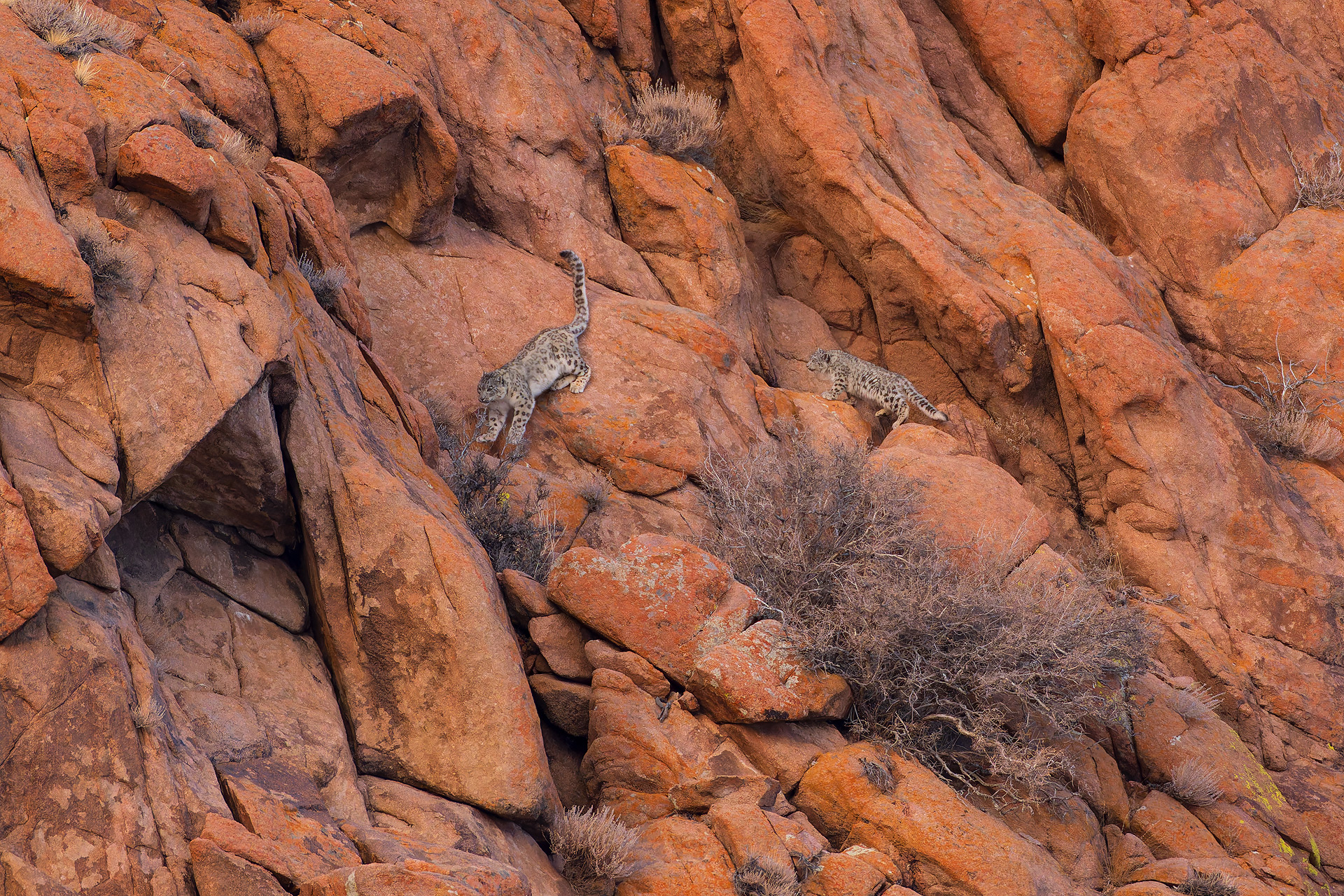 © Andy Rouse | Sony α1 II + FE 600mm f/4 GM OSS + 1.4x Teleconverter | 1/640s @ f/5.6, ISO 3200
Having been a pro for over 25 years, Andy only switched to Sony Alpha in the last 18 months, but has already seen the benefit. Shooting the Snow Leopards with his Sony A1 II and the FE 600mm f/4 GM lens, as well as enjoying the FE 200-600mm f/5.6-6.3 G OSS and FE 300mm f/2.8 GM OSS, “I think the best compliment I can pay these cameras and lenses is that they remove the ‘can’t’ from your thinking,” he says.
“Particularly, the Alpha 1 II’s 50 megapixel resolution has been pivotal for projects like this,” he continues, “because I can crop into the frame to extend my reach. If I halve the resolution to 25 megapixel, that 600mm doubles to a 1200mm, and with the TC 1.4x teleconverter, it’s almost 1700mm. Perfect for a big cat that doesn't want to be anywhere near you. The detail and clarity is also vital in selling prints and images to the media, because that’s what makes me a professional photographer.
 © Andy Rouse
Andy’s journey has also seen him balancing photographic expectations with personal goals, he says. “With experience you become more of a realist,” he explains, “and for me, any encounter like this one is a privilege, the pictures are a bonus. You don’t think about photos in the same way because you’re witnessing something so rare and precious. But of course, the photos are important, too, because each one had the power to help a conservationist gain funding or educate a kid that there’s beauty in our world that we need to protect.”
Over the past year, working with Sony gear, and with a rekindled love of what he does, Andy has seen the effect in his images, too. “I’ve started winning awards again this year, and I think a lot of that comes from what people feel when they look at my photos. All of my experience is still going in there, but there’s also the joy I was missing for a long time. Joy that comes from seeing the things I love and helping to preserve them.”


